+86 13794985240


Choosing the right Connecting Rod in 2026 requires more than comparing price lists. Global buyers must evaluate engine type, production volume, supplier capability, and operating conditions together. The International Energy Agency reported that electric car sales exceeded 17 million in 2024, representing more than one-fifth of global new-car sales. This shift is changing demand for traditional engine components. Yet internal-combustion engines remain important in commercial vehicles, hybrid systems, motorcycles, agricultural equipment, and replacement markets.
The opportunity is still substantial. According to OICA, global vehicle production exceeded 93 million units in 2023. That scale creates strong demand for reliable, traceable, and application-specific connecting rods. However, volume alone does not prove quality. A rod used in a high-speed diesel engine may require different material strength, fatigue resistance, and surface treatment than one used in a passenger-car engine. SAE technical standards and ASTM material specifications can support comparison, but they do not replace practical validation. Ask for tensile results, hardness data, dimensional reports, shot-peening records, and fatigue-test evidence.
Small details matter. Check the big-end bore after machining. Confirm bolt stretch, not only bolt torque. Review heat-treatment consistency across production batches. These checks can prevent expensive field failures.
No single report answers every sourcing question. Market forecasts can also change quickly. IEA data reflects energy trends, while OICA data reflects manufacturing volume. Neither guarantees supplier performance. Experienced buyers should combine industry data, factory audits, sample testing, and clear warranty terms before approving a Connecting Rod supplier. That process may feel slower, but one overlooked tolerance can cost far more than a careful evaluation.
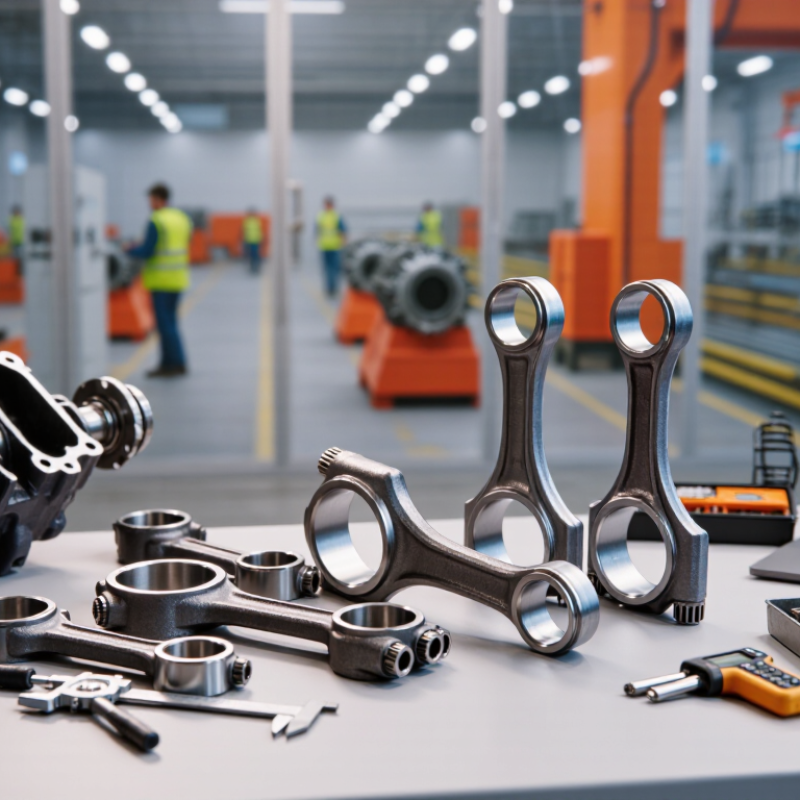
Choosing connecting rods for global buyers begins with understanding their types and working environments. A forged steel rod suits high-cylinder-pressure engines, including heavy-duty vehicles and industrial power units. It tolerates repeated loads and temperature changes. A cast steel rod can reduce cost for moderate-duty applications. However, its fatigue margin may be lower.
The beam shape also affects performance. I-beam rods are relatively light and common in performance engines. H-beam designs provide greater stiffness for high-output engines, though they may add weight.
Tubular or specialized rods appear in selected racing, aerospace, and compact machinery applications. Aluminum rods reduce reciprocating mass, but they often need closer inspection and shorter service intervals. Titanium rods are light and strong, yet their cost and surface-care requirements limit wider use.
Application details matter more than appearance. A motorcycle engine may favor low mass and fast acceleration. A marine engine needs dependable fatigue resistance during long operating periods. Compressor rods face different loads, especially during continuous cycling. Buyers should check material certificates, heat treatment, dimensional reports, and big-end roundness. Confirm the pin diameter, center-to-center length, bolt specification, and required clearance. Small errors can create noise or rapid wear. In practice, selecting only by beam shape is risky. I have seen lightweight choices perform poorly when lubrication and alignment were overlooked. Load data is sometimes incomplete, so engineers should verify assumptions before production.
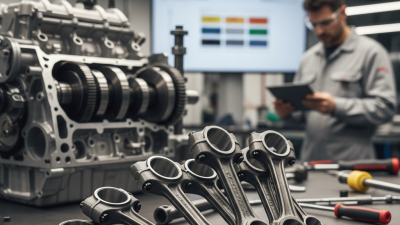
2026 How to Choose Connecting Rods for Global Buyers?
For global buyers, connecting rod selection starts with material, not catalog price. Forged alloy steel remains common because it balances fatigue resistance, toughness, and machinability. Powder-metal rods may reduce machining waste, but density and porosity require closer inspection. The 2024 World Steel in Figures report records 1.89 billion tonnes of crude steel production in 2023. That scale does not guarantee suitable rod steel. Ask for heat numbers, chemical analysis, and traceable mill certificates. Small paperwork gaps can become large warranty problems.
Strength must be verified under real loads. Request tensile strength, yield strength, elongation, hardness, and fatigue-test results. ASTM A370 provides recognized methods for testing steel products. A report showing only ultimate tensile strength is incomplete. Rods experience tension, compression, bending, and repeated impact near the small end. Dimensional control matters too. Measure bore roundness, center distance, twist, and cap alignment after machining. In purchasing reviews, a strong sample sometimes failed because the big-end bore was slightly misaligned. That was not dramatic. It was expensive.
Manufacturing quality depends on forging temperature, grain flow, heat treatment, shot peening, and non-destructive testing. Request ultrasonic or magnetic-particle records, process capability data, and inspection frequency. The ISO Survey 2023 lists more than 1.2 million ISO 9001 certificates worldwide, but certification alone proves little about each batch. Audit the actual line. Watch operator checks, gauge calibration, and quarantine procedures. One uncomfortable question remains: can the supplier reproduce the same hardness after six months? If the answer is vague, keep testing. Do not confuse a polished sample with stable production quality.
Technical comparison of commonly specified connecting-rod materials and quality-control requirements. Values are typical engineering ranges and should be confirmed against the supplier’s drawing, material certificate, and application load calculation.
| Material / Construction | Typical Manufacturing Route | Typical Tensile Strength | Typical Yield Strength | Typical Hardness | Fatigue and Strength Characteristics | Dimensional and Surface Quality Checks | Suitable Application Profile | Buyer Verification Documents |
|---|---|---|---|---|---|---|---|---|
| Medium-carbon forged steel Example: C45 / AISI 1045 |
Closed-die forging, normalizing or quench-and-temper heat treatment, shot peening, precision machining | Approximately 570–750 MPa | Approximately 300–550 MPa | Approximately 170–230 HB after normalizing or tempering | Good general-purpose strength and machinability; fatigue performance depends strongly on fillet radius, grain flow, surface finish, and shot-peening coverage | Bore diameter, center distance, big-end roundness, small-end alignment, fillet radius, surface roughness, and magnetic-particle inspection | Passenger vehicles, light commercial engines, agricultural and general industrial engines with moderate cylinder pressure | Heat-treatment record, chemical composition report, dimensional inspection report, and non-destructive testing report |
| Alloy forged steel Example: 42CrMo4 / AISI 4140 |
Closed-die forging, quench and tempering, optional induction hardening or shot peening, CNC finishing | Approximately 850–1,100 MPa | Approximately 650–950 MPa | Approximately 240–330 HB after quench and tempering | Higher strength and toughness than medium-carbon steel; suitable for higher combustion loads when the forging grain flow and heat treatment are controlled | Ultrasonic testing for internal discontinuities, magnetic-particle testing for surface cracks, bore geometry, parallelism, hardness mapping, and residual-stress control | High-load automotive, commercial-vehicle, performance, marine, and stationary engines | Material certificate to EN 10204 3.1 or equivalent, heat-treatment chart, forging-process record, NDT results, and capability data for critical dimensions |
| Microalloyed forged steel Vanadium-microalloyed grade |
Controlled forging followed by air cooling; machining, fracture splitting or precision cap separation, and shot peening | Approximately 800–1,000 MPa | Approximately 650–850 MPa | Approximately 250–320 HB | Good strength-to-cost ratio and reduced heat-treatment distortion; process control is essential because properties depend on forging temperature and cooling rate | Forging-temperature records, microstructure examination, fracture-split surface inspection where applicable, bore size, cap fit, and crack detection | High-volume passenger-car and light commercial engines requiring stable production cost and repeatability | Microstructure report, process-control plan, statistical process capability for bores, and traceability from steel heat to finished part |
| Powder-forged steel | Compacted preform, sinter forging, sizing, heat treatment, machining, and optional fracture splitting | Approximately 700–1,000 MPa | Approximately 500–800 MPa | Approximately 200–300 HB | Near-net-shape production and consistent weight; fatigue performance is influenced by density, residual porosity, inclusions, and surface condition | Density measurement, metallographic porosity evaluation, dimensional inspection, hardness testing, crack inspection, and balance or weight verification | High-volume engines where repeatable geometry, low material waste, and controlled mass are important | Powder specification, density distribution data, sintering and forging records, metallography, and production-part approval documentation |
| Titanium alloy Example: Ti-6Al-4V |
Closed-die forging or billet forging, solution treatment and aging where specified, precision machining, and surface finishing | Approximately 900–1,050 MPa | Approximately 830–950 MPa | Approximately 32–38 HRC | Low density, typically about 4.43 g/cm³, reduces reciprocating mass; high material cost and strict control of surface defects, notch sensitivity, and galling are required | Ultrasonic inspection, dye-penetrant testing, dimensional inspection, surface-roughness measurement, microstructure evaluation, and thread or bore quality checks | Specialized racing, aerospace-derived, and premium performance applications where low reciprocating mass justifies higher cost | Full material traceability, forging and heat-treatment records, ultrasonic and penetrant reports, tensile test results, and approved surface-treatment records |
| Aluminum alloy Example: 7075-T6 |
Forging or precision machining, solution heat treatment, artificial aging, and hard-anodizing or other approved surface treatment where required | Approximately 510–600 MPa | Approximately 430–520 MPa | Approximately 135–175 HB | Very low density, typically about 2.8 g/cm³, but lower stiffness, lower wear resistance, and lower high-temperature capability than steel; design requires careful fatigue and bearing analysis | Dimensional inspection, bore wear evaluation, penetrant testing, hardness verification, conductivity testing, and surface-treatment thickness checks | Low-load or specialized performance engines with strict limits on temperature, duty cycle, and bearing loading | Alloy and temper certificate, heat-treatment record, conductivity or hardness result, penetrant inspection, and dimensional report |
Choosing connecting rods begins with dimensions, not appearance. The rod length must match the crank stroke, piston compression height, and intended deck clearance. Measure center-to-center length carefully. Then verify the big-end bore against the crankshaft journal diameter and target oil clearance. A difference of a few hundredths of a millimeter can change bearing behavior. Small-end width and wrist-pin diameter must also match the piston. Do not assume similar engines share these measurements.
A reliable check uses engine service data, a calibrated micrometer, and a connecting-rod gauge. Record every value before ordering. Check rod width at both ends, bolt spacing, bearing tang location, and side clearance. These details affect assembly fit inside the crankcase.
If the rod is too wide, it may contact the crank web. If it is too narrow, excessive side movement may disturb lubrication. That small gap matters. Material and beam design matter after dimensions are confirmed. Forged steel may suit demanding duty, but required strength depends on speed, load, and engine use.
A careful buyer should request inspection records, dimensional tolerances, and hardness information from the supplier. Ask how the finished bore was measured. Surface finish and roundness are not cosmetic details. They influence bearing life. It is tempting to select a rod by length alone. That shortcut can create piston-to-head contact, poor compression, or costly rework. Even experienced technicians can miss a width or pin mismatch. Recheck the complete assembly with precision clearance tools before final installation. Not glamorous, but necessary.
Global buyers should judge connecting-rod suppliers through evidence, not attractive catalogs.
The ISO Survey 2022 recorded 1,265,216 ISO 9001 certificates across 189 countries and economies. Certification shows process discipline, but it does not guarantee fatigue strength or dimensional stability.
Request the supplier’s valid certificate, certification scope, audit date, and manufacturing address. Then verify the certificate through the issuing body.
A reliable supplier should provide material certificates, heat-treatment records, dimensional reports, and full batch traceability.
Ask for tensile strength, hardness, shot-peening results, and fatigue-test methods.
Standards may include ISO 9001, IATF 16949, ISO 14001, ASTM, EN, or JIS requirements, depending on the engine application.
Do not accept a generic “meets international standards” statement. It is too vague.
The World Bank’s Logistics Performance Index 2023 highlights major differences in customs, infrastructure, and shipment reliability between economies. Therefore, evaluate delivery performance with evidence.
Review the last twelve months of on-time delivery data, packaging tests, export documents, and corrective-action records.
A supplier should explain how it controls forged blanks, machining variation, and mixed batches.
Remote audits help, but they cannot replace an occasional factory visit.
My checklist is not perfect. Small documentation gaps can still reveal larger process weaknesses. Ask difficult questions, and record every answer.
Price is only the visible part of a connecting rod purchase. Compare material grade, fatigue strength, machining tolerance, packaging, and landed cost. OICA reported more than 93 million motor vehicles produced globally in 2023, keeping demand for reliable engine components high. However, high volume does not guarantee stable supply. The World Bank’s 2023 Logistics Performance Index shows significant differences in customs, infrastructure, and shipment reliability between markets. A low unit price can become expensive after port storage, inspection delays, or rejected batches.
Logistics planning needs more than a freight quotation. UNCTAD’s Review of Maritime Transport 2024 reported continued disruption and higher route uncertainty in global shipping. Ask suppliers for realistic lead times, backup ports, moisture-resistant packaging, and batch-level traceability.
Warranty terms should define coverage, mileage, inspection evidence, and response time. A 24-month warranty sounds useful, but exclusions may quietly remove fatigue failures or installation errors. This is where buyers must read carefully. Even experienced teams can overvalue a clean spreadsheet.
Tips: Compare total landed cost, not factory price. Request sample fatigue-test reports and dimensional records. Confirm whether replacement parts, freight, and technical analysis are included in warranty claims. Keep a small safety stock for critical applications. It may feel inefficient. Sometimes it prevents a costly production stoppage. Ask for corrective-action records, not promises. A supplier’s long-term value appears in consistent batches, clear communication, and fewer unexpected claims.